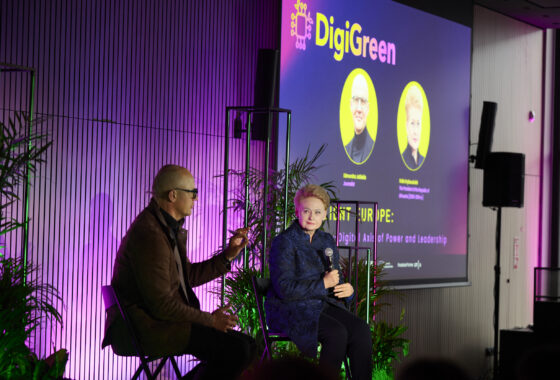
On June 4, the international conference DigiGreen 2026, held in Vilnius, brought together policymakers, business leaders, researchers, investors, and technology experts from Lithuania and abroad to discuss the key challenges and opportunities shaping Europe’s future. Organized by Sunrise Tech Park for the fifth time, the event focused on topics that are defining Europe’s path forward—from energy and artificial intelligence to investment, security, advanced technologies, and future skills.
As Europe continues to face geopolitical, economic, and climate-related challenges, the need to strengthen strategic autonomy and adaptability in an increasingly complex environment has become a growing priority. These themes were at the heart of the discussions throughout DigiGreen 2026. Opening the conference, Lithuania’s Minister of the Economy and Innovation, Edvinas Grikšas, and Andrius Grigonis, Vice Mayor of Vilnius, emphasized the importance of innovation in driving economic growth. Meanwhile, Laima Balčiūnė, CEO of Sunrise Tech Park, presented an overview of Lithuania’s cleantech sector and its potential in international markets.
This year’s conference stood out not only for the breadth of topics covered but also for its ability to bring together experts from diverse fields to engage in a common conversation about Europe’s future. From energy and artificial intelligence to investment, education, defence, and urban development, every session explored how technology and innovation can contribute to building a stronger, more competitive, and more resilient Europe.
Technology, Innovation, and Competitiveness at the Core
The conference programme covered a wide range of topics, including energy and industrial transformation, artificial intelligence, the data economy, smart cities, emerging technologies, and the development of future skills. Discussions focused on how Europe can maintain its competitiveness in a rapidly changing geopolitical and technological landscape.
One of the first panel discussions featured Audronė Janulaitytė, Industrial Projects Manager at Manufuture LAB; Vidmantas Janulevičius, President of the Lithuanian Confederation of Industrialists; Airidas Daukšas, Vice Minister of Energy; and Torsten Merkel, CEO of N1 Capital. Together, they examined Europe’s ability to maintain leadership in cleantech amid growing global competition. The discussion addressed the challenges of decarbonising heavy industry, strengthening energy independence, the role of technological innovation, and policy measures that could help European industry remain competitive while accelerating its digital transformation.
In a discussion dedicated to digital transformation, Karolis Mirinavičius, Head of Innovation at Ignitis Group; Rūta Grigaliūnaitė, Sustainability Lead at Hostinger; Šarūnas Stanaitis, CEO of Inion; and Linas Dičpetris, Partner at EY, explored how growing investments in artificial intelligence, data infrastructure, and digital technologies are transforming business and society. Particular attention was given to ensuring that digital transformation remains not only innovative but also sustainable—from energy-efficient data centres and algorithm optimisation to responsible data use and solutions that align technological progress with climate goals.
Throughout the conference, speakers repeatedly emphasized that technological development can no longer be viewed separately from economic, energy, and societal needs. Artificial intelligence, data utilisation, and digital solutions are becoming an integral part of both business and public-sector operations, while the ability to apply these technologies effectively increasingly determines organisational competitiveness. Discussions also focused on how technological change is reshaping the labour market and what skills future professionals will need.
Equally important were conversations about urban transformation and sustainable infrastructure. Experts explored how data-driven decision-making, smart technologies, and cross-sector collaboration can contribute to creating more efficient, inclusive, and citizen-focused cities. The discussions highlighted that the future of cities depends not only on technological solutions but also on the ability to adapt them to real societal needs.
From Energy Security to Geopolitical Resilience
One of the defining themes of this year’s conference was resilience—economic, energy, technological, and geopolitical. Experts in investment, energy, and innovation discussed how Europe can strengthen its ability to respond to crises, ensure energy security, and build long-term competitive advantages. Speakers stressed that resilience is becoming just as important as the pace of innovation or economic growth, and that long-term success depends on the ability to build reliable systems capable of withstanding disruption.
Particular attention was given to the role of cleantech in security and defence. In a discussion moderated by Kädi Ristkok, Director of Energy and Climate at Transport & Environment, Mariano Berkenwald, Head of Strategy at INERATEC, and Ben Cook, United Kingdom Representative at the NATO Energy Security Centre of Excellence, examined how geopolitical tensions and global supply-chain disruptions have reinforced the importance of energy independence for national and regional security.
The discussion explored the potential of cleantech to strengthen resilience—from decentralised renewable energy systems and advanced energy-storage technologies to dual-use innovations that can support both climate objectives and strategic autonomy. Panelists highlighted that energy efficiency, digital infrastructure, and resilient logistics are becoming increasingly important factors in building a safer and more competitive Europe.
The conference culminated in a conversation moderated by journalist Edmundas Jakilaitis with Dalia Grybauskaitė, President of the Republic of Lithuania from 2009 to 2019. One of the most anticipated sessions of the event focused on Europe’s geopolitical resilience, leadership, and ability to act in an era of growing uncertainty.
The discussion examined how governments, institutions, and businesses can respond to overlapping security, economic, and energy challenges, as well as what strategic decisions and partnerships are needed to maintain stability and strengthen Europe’s position in an increasingly complex geopolitical environment. Participants also discussed the protection of democratic values, strategic autonomy, and the importance of strengthening long-term resilience at a time when the world continues to face persistent crises and rapid change.
The conversation served as a symbolic culmination of the conference, bringing together many of the event’s central themes—from energy security and technological progress to competitiveness and Europe’s future vision.
A Conference Where Experts, Ideas, and Partnerships Meet
This year’s DigiGreen conference welcomed experts and speakers from Lithuania, Germany, the United Kingdom, Italy, Latvia, and Estonia. Participants included leaders from business, investment, energy, technology, science, and the public sector, who shared not only their insights but also practical experience on addressing today’s challenges and creating opportunities for the future.
Alongside the conference programme, networking remained a key part of the event. Participants had the opportunity to establish new connections, explore potential collaborations, and exchange experiences with experts and representatives from various organisations. The growing involvement of international organisations, speakers, and attendees demonstrates that DigiGreen is becoming an increasingly important platform for dialogue on Europe’s green and digital transformation, as well as a place where new partnerships, ideas, and joint projects emerge.