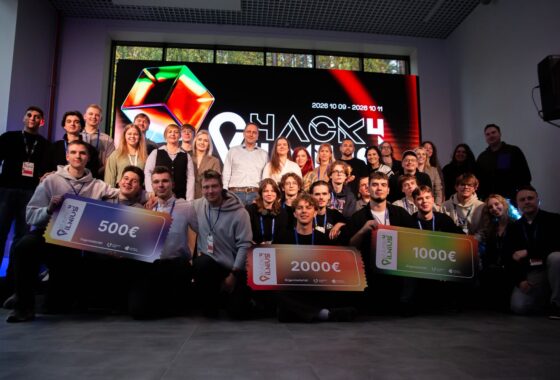
From 9 to 11 October, the ninth edition of Hack4Vilnius 2026, a city hackathon organised by Sunrise Tech Park in collaboration with Vilnius Gediminas Technical University (VILNIUS TECH), took place in Vilnius. The three-day event brought together more than 100 participants at the VILNIUS TECH Plytinė campus. Working in 34 teams, participants tackled real-world challenges presented by businesses and organisations operating in the Lithuanian capital.
This year’s first place went to SLLAB (Synthetic Logic Lab), which presented a prototype of Vilkas, a mobile app designed to help identify and prioritise problems across Vilnius. The team received a €2,000 cash prize.
Second place was awarded to TJ, a team that developed a system to optimise waste collection in Vilnius. Third place went to Dilgėlė, which created an extension for the JUDU app, designed to make time spent on public transport more engaging and meaningful.
According to Jaroslav Sadovskis, Head of Cognizant in Lithuania and Poland, whose company has been a long-standing partner of the event, this year’s hackathon once again demonstrated that the best ideas emerge when technology, creativity, and diverse perspectives come together to address real-world challenges.
“It is particularly encouraging to see participants using artificial intelligence not as an end in itself, but as a practical tool to create tangible value for the city and its residents. I hope the prototypes developed over these three days will lay the groundwork for solutions we will one day see implemented in Vilnius,” says Jaroslav Sadovskis.
Nine Years of Ideas for Vilnius
Organised annually since 2018, Hack4Vilnius has brought together more than 1,000 participants over the past nine years. This year’s challenges reflected a wide range of aspects of life in Vilnius, from everyday mobility and urban infrastructure to the innovation ecosystem and services for residents.
Throughout the event, participants worked intensively on developing their solutions while also preparing to present them to the jury. On Sunday evening, a panel of judges evaluated the teams’ pitches and awarded a total prize fund of €3,500.
The jury consisted of Laima Balčiūnė, Director of Sunrise Tech Park; Monika Rakickė, Senior Business Analyst at Cognizant Technology Solutions Lithuania; Vaidas Paulauskis, Director of ID Vilnius; and Sigita Zulonienė, Operations Manager at LitBAN.
The solutions were evaluated based on several criteria, including innovation, market potential, level of implementation, use of open data analysis, and overall presentation quality.
The Winning Teams and Their Solutions
First place: SLLAB (Synthetic Logic Lab) – Vilkas, a City Problem Reporting App
The winning team, SLLAB (Synthetic Logic Lab), tackled a challenge proposed by VILNIUS TECH researchers: how can Vilnius identify and prioritise urban problems more quickly?
The team’s analysis revealed that nearly one in five reports submitted through the tvarkaumiesta.lt platform results in no action being taken due to insufficient evidence, duplicate submissions, or inaccurate information. It also found that most young Vilnius residents never report problems they encounter in the city, either because they do not know where or how to do so, or because they lack confidence that the issues will be resolved.
To address these challenges, the team developed a prototype of Vilkas, a mobile app that acts as a city problem radar. Using artificial intelligence, residents can report issues they encounter in just a few taps. People nearby can then confirm previously unverified reports, helping to validate the information.
The app also incorporates gamification features to encourage participation, including points, challenges between neighbourhoods, schools, and companies, and real prizes provided by partners.
For the municipality, Vilkas offers an intelligent report management system. Reports that are inappropriate or lack sufficient evidence are automatically filtered out, while priorities are determined based on the number of confirmations, urgency, location, and emerging trends. This enables issues to be assigned to the relevant teams more quickly and accurately.
To develop the solution, the team used open data from the public data map of Lithuania’s Information Technology and Communications Department and the Vilnius Open Data Portal.
Second place: TJ – Smarter Waste Collection in Vilnius
The TJ team secured second place and a €1,000 cash prize for developing a solution to optimise waste collection in Vilnius using open data.
The team analysed nearly 13 million waste collection records from VASA, covering the period from 2023 to 2026 and approximately 128,000 containers. Using this data, they reconstructed actual waste collection routes across the city and developed a demand forecasting model.
Based on historical collection and weighing data, the model predicts which containers need to be emptied on a given day, helping to make waste collection more efficient.
The solution also includes a working Internet of Things (IoT) prototype. An ultrasonic sensor connected to an Arduino platform measures how full a container is, allowing the system to automatically adjust collection routes as soon as new data is received.
Third place: Dilgėlė – Making Public Transport Journeys More Engaging
The Dilgėlė team took third place and received a €500 cash prize for addressing the challenge of making everyday journeys on Vilnius public transport more valuable and enjoyable.
The team developed an extension for the JUDU app, designed to help passengers make better use of their travel time, whether their journey lasts 15 minutes or an hour and a half.
While travelling, passengers can discover information about landmarks along their route, explore local history and interesting facts, join short multiplayer games with fellow passengers on the same vehicle, or play individual games and earn points.
The ninth edition of Hack4Vilnius once again demonstrated how bringing together open city data, challenges set by local institutions, and creative teams can lead to solutions with the potential to make a real difference in just three days.
The organisers hope that the ideas developed during the hackathon will continue to evolve beyond the event and contribute to making Vilnius a smarter, more convenient, and more liveable city.
Other news